Monthly
US$40/ month
For shorter projects.
Choose monthly Solpile
Single pile analysis
From layered soil to pile response. Model lateral loading, explore nonlinear behaviour and prepare clear engineering reports.
From US$40 / month
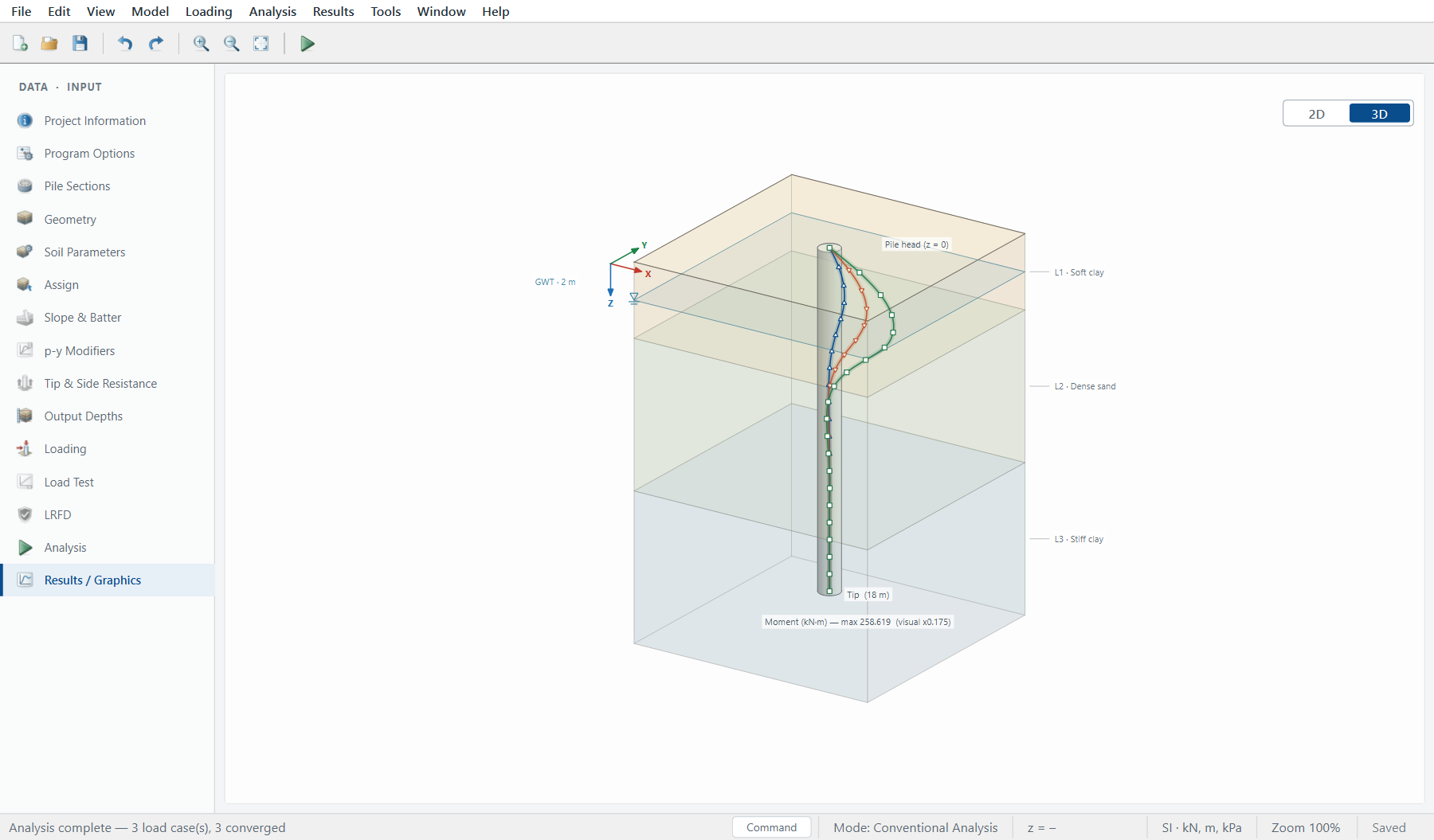
The p-y method, with a finite-difference beam-on-springs solver and P–Delta effects.
Model clay, sand and rock, groundwater, slope and pile batter. Apply static or cyclic lateral loads.
Work with concrete, steel and prestressed sections. Explore moment-curvature behaviour and axial load–moment interaction.
Compare pile-head and distributed loads, soil movement and LRFD combinations. Run pushover, buckling, stiffness and pile-length studies.
Review deflection, bending moment, shear and soil reaction. Export tables and reports to PDF, Word and Excel.
Trace response along the pile and inspect the p-y curves at the depths you choose. Use SI or US units throughout your project.
View example report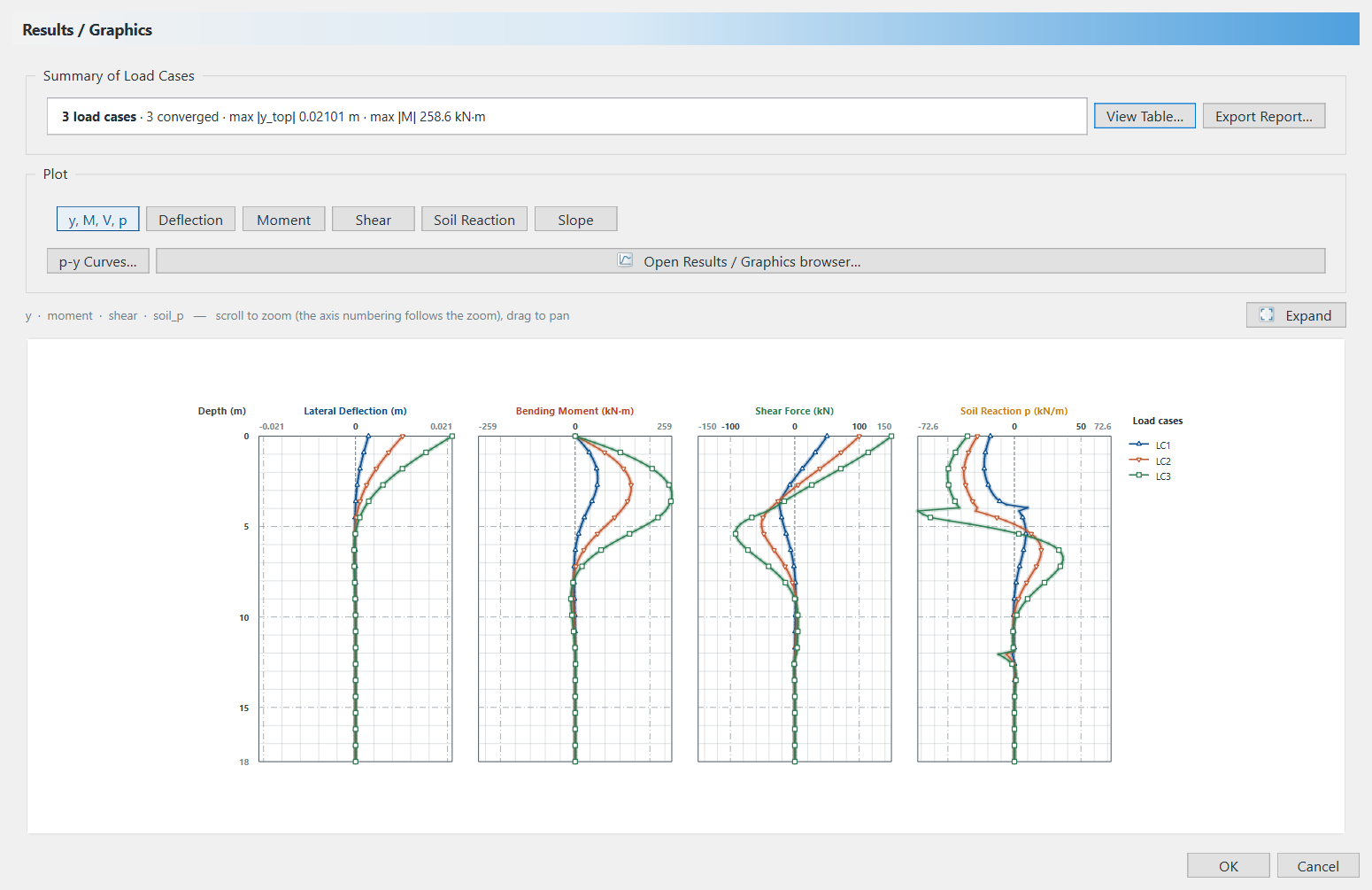
Solpile, with monthly or annual access.
US$40/ month
For shorter projects.
Choose monthlyUS$384/ year
Equivalent to US$32 / month, paid annually.
Choose annualWant to explore it first? Request a 7-day free trial.
Analysis: lateral response of a single pile in layered soil. Axial thrust contributes to P–Delta and section response. Use Solgroup for pile group modelling.
Workflow: native .lpx projects, multiple load cases, multi-file analysis, SI/US units, and command-line/Python automation.
Platform: Windows desktop. Final installer requirements will accompany the release.
Engineering use: select appropriate soil models and parameters, review convergence and run notes, and check results against the design requirements.